
Protoworks Prototype Building Blocks
Utility modules for rapid and reliable bench testing
These boards are practical engineering modules rather than mass-market consumer products. They are utility modules—repeatable, validated circuits for common functions that appear across multiple embedded projects. Rather than rebuilding basic power rails, communication interfaces, or IO arrays from scratch on a piece of protoboard, these blocks provide a known-good starting point. These designs can also be customized and adapted to fit the specific needs of individual customer projects.
The development process, design decisions, and bench-testing phase of some of these boards are documented in detail within the Field Notes section, which links directly to the founder's personal engineering journal at JKTDEV.CO.UK.
Need a prototype board adapted for your project?
These boards are available as starting points for custom embedded, automation, and hardware prototyping work. Small sample batches may also be available while designs are being validated.
Contact ProtoworksOverview & Approach
🔧 Development Focused
Through-hole headers and connectors are left unpopulated by default, giving you maximum flexibility in how you wire them into your project, prototype bench, or enclosure.
📡 4-Layer Layouts
Standardized around 4-layer PCBs to provide cleaner power and ground referencing, helping reduce avoidable layout-related noise during early testing.
📝 BOM Transparency
Designed using standard, readily available 0603 and 0805 component footprints. Fully open hardware under the CERN-OHL-W-2.0 licence, with KiCad project files and multi-supplier bills of materials.
🛡️ Basic Safeguards
Built with practical workbench protection features intended to reduce damage from common prototyping mistakes, such as brief shorts, transients, and some reverse-polarity wiring errors.
⚡ Power
Reliable power delivery, voltage regulation, and transient protection modules designed to provide a stable foundation for hardware prototyping.
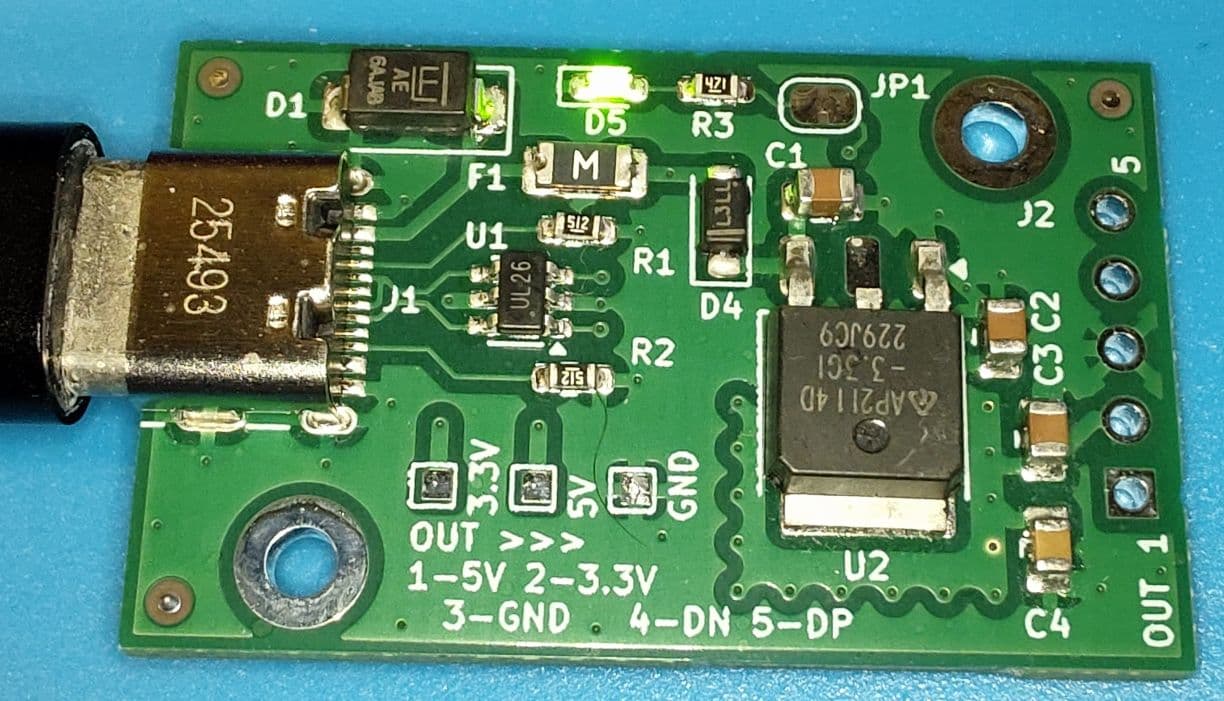
USB-C Power Input & 3.3 V Regulator Board
A simple power entry utility that combines USB-C power handling with a local 3.3 V regulated rail.
The Friction It Removes
Circuit & Layout Details
- Regulator: Based on the AP2114D-3.3 linear regulator (LDO) providing a stable 3.3 V output.
- Input Protection: Includes a 500 mA hold / 1 A trip PPTC resettable fuse, an SMAJ5.0A TVS diode on VBUS for transient clamping, and an MBR130LSFT1G Schottky diode for basic backfeed protection.
- Data Protection: Includes a USBLC6-2SC6 ESD protection array on the D+ and D− lines, which are broken out to pins for optional connection to external USB-to-UART converters.
- Power Gating: Features a solder jumper to disconnect the power indicator LED when minimizing power budgets for low-power or battery-operated testing.
- Interface: Standard 2.54 mm breakout pins for 5 V, 3.3 V, GND, D−, and D+, with dual M2 mounting holes for temporary bench installation.
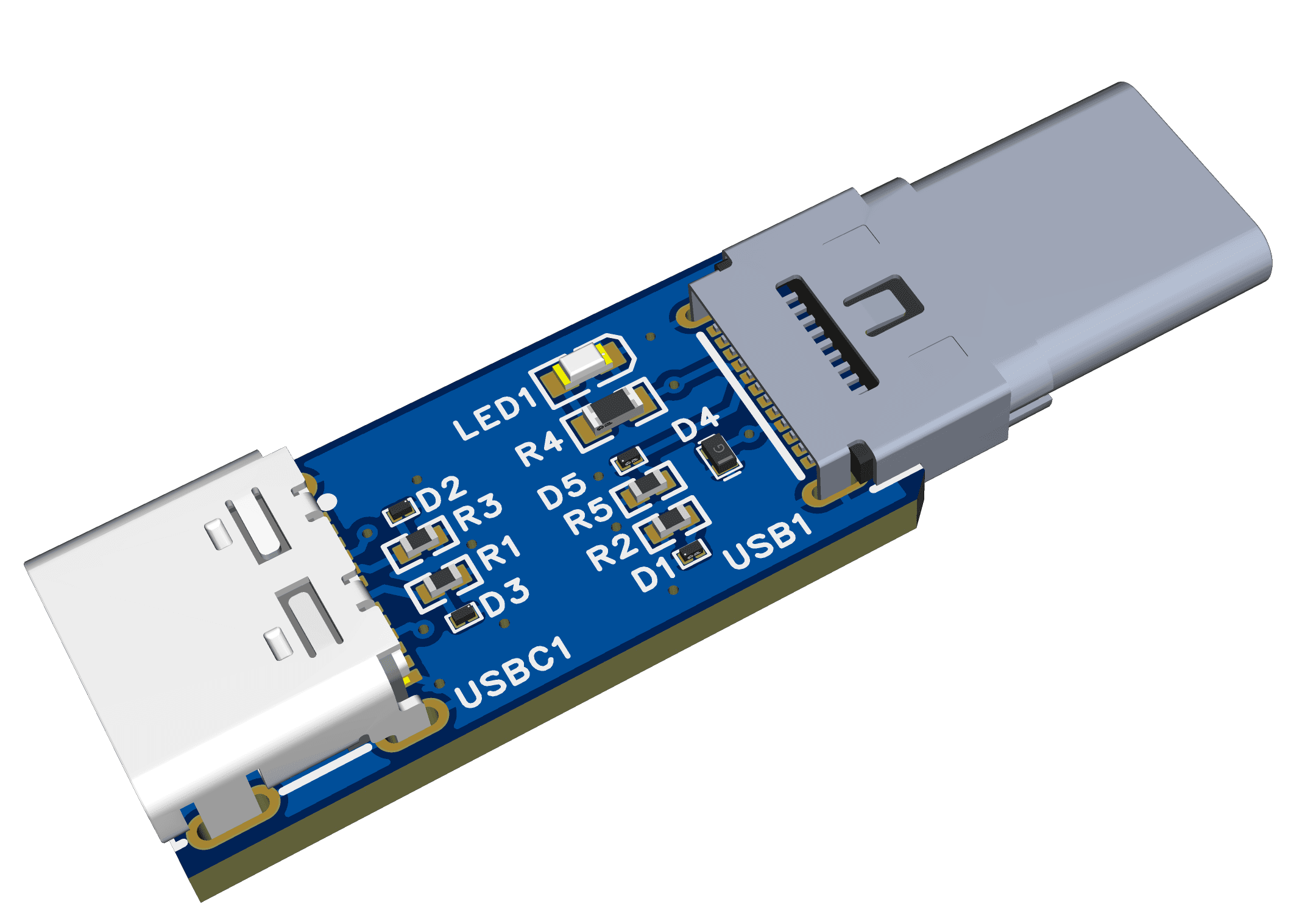
USB-C Data Shield (USB Condom)
A hardware-level data blocker that allows safe device charging from public or untrusted USB-C ports by physically isolating all data lines.
The Friction It Removes
Circuit & Layout Details
- Physical Data Isolation: Complete severance of USB-C high-speed and legacy data lines (D+, D−, TX+, TX−, RX+, RX−, SBU1, SBU2). There are no copper trace connections for these pins between the input and output connector footprints.
- Basic Charging Support: Uses dedicated 5.1 kΩ pull-down resistors (Rd) on the Configuration Channel (CC) lines. This advertises a standard UFP (Upstream Facing Port) role to the power source, enabling basic 5 V charging (up to 1.5 A or 3.0 A depending on source capability) without Power Delivery (PD).
- No PD Negotiation: Intentionally bypasses USB Power Delivery (PD) controllers to ensure the voltage never climbs above a baseline 5 V, protecting the connected device from unexpected high-voltage negotiation or protocol exploits.
- ESD Protection: Features a high-speed TVS diode array on the VBUS power rail to protect the connected device from electrostatic discharge and public charger power surges.
📡 Communications
Robust differential signaling and serial interface converters designed for reliable data transmission in noisy environments and over long distances.
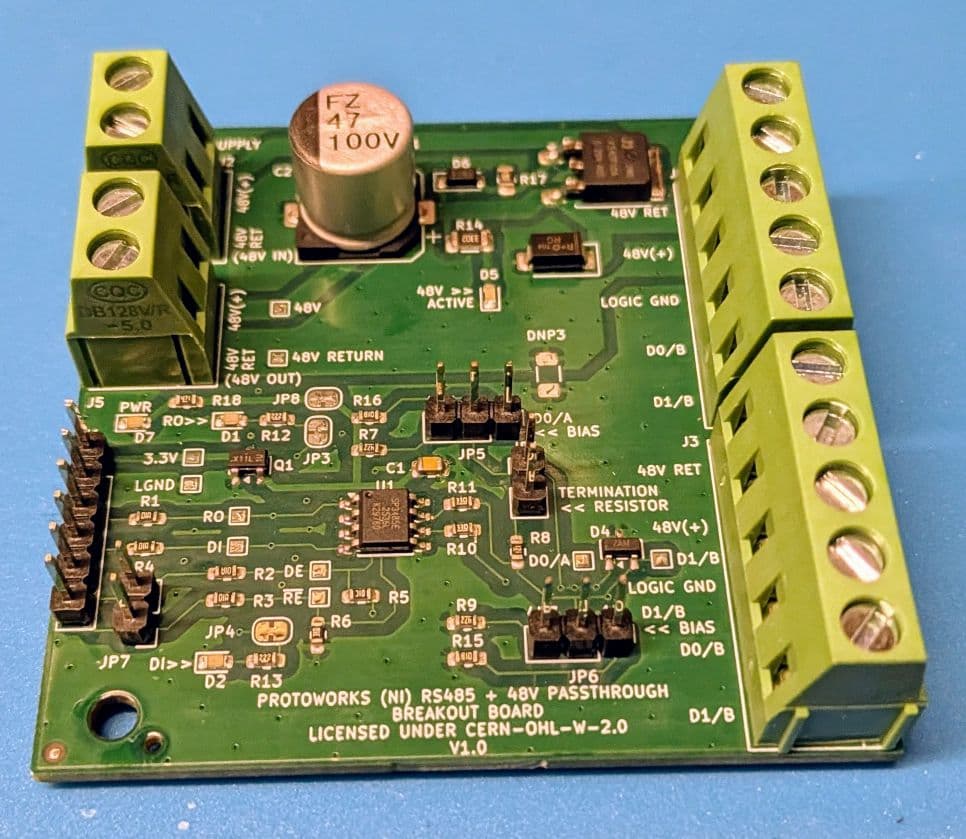
RS485 Breakout with 48 V Passthrough Board
A straightforward non isolated differential serial interface for testing robust communication over longer cable runs, featuring a 48 V power passthrough option.
The Friction It Removes
Circuit & Layout Details
- Transceiver: Based on the 3.3 V MaxLinear SP3485EN differential transceiver.
- Bus Configuration: Includes onboard jumper-selectable 120 Ω bus termination and selectable bus biasing (using either stronger 1 kΩ or weaker 4.7 kΩ resistors) to establish the idle state of the bus.
- Direction Control: A single jumper links the DE and /RE lines, allowing a single microcontroller GPIO to control the transmit/receive state.
- 48 V Passthrough: Routes a high-voltage auxiliary supply across nodes for distributed systems. The 48 V path is protected by a conventional SMD fuse, a TVS diode, and P-channel MOSFET reverse-polarity protection.
- Layout Separation: Non-isolated design, but laid out with physically distinct 48 V return and logic ground regions to prevent heavy current return loops from interfering with low-voltage logic references.
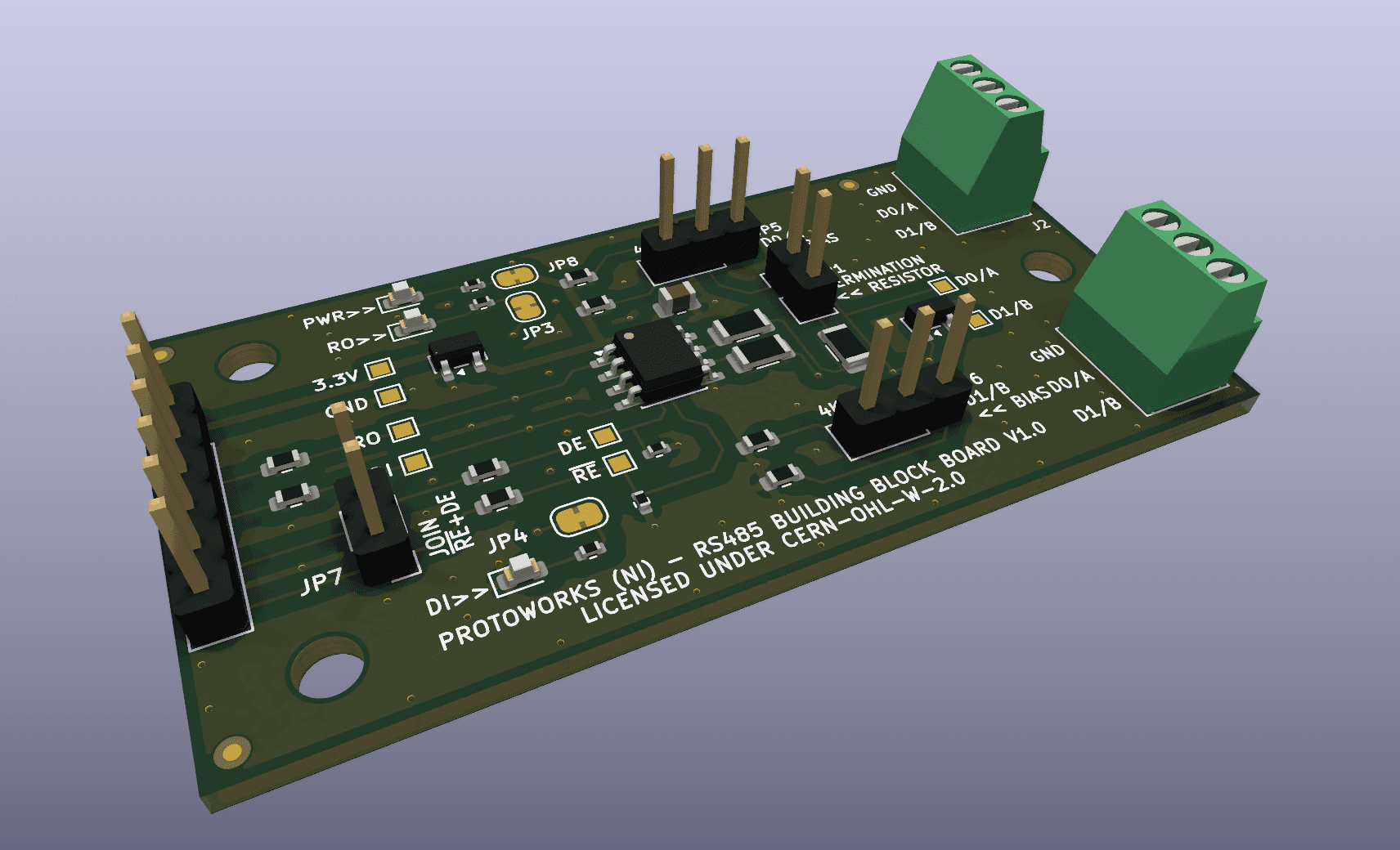
RS485 Non Isolated Breakout Board
A clean, non-isolated differential serial interface focusing purely on low-noise half-duplex communication without auxiliary high-voltage power routing.
The Friction It Removes
Circuit & Layout Details
- Transceiver: Based on the 3.3 V MaxLinear SP3485EN differential transceiver.
- Bus Configuration: Includes onboard jumper-selectable 120 Ω bus termination and selectable bus biasing (using either stronger 1 kΩ or weaker 4.7 kΩ resistors) to establish the idle state of the bus.
- Direction Control: DE and /RE lines are optionally linked via jumper to a single microcontroller GPIO to easily control half-duplex transmit/receive states.
- ESD Protection: Features a dedicated TVS array to protect against electrostatic discharge (ESD) and transients on the differential bus lines.
🎛️ Input / Output (I/O)
Deterministic, shift-register-based input/output expansion modules to scale digital logic pins without complex protocol overhead or bus lockup risks.
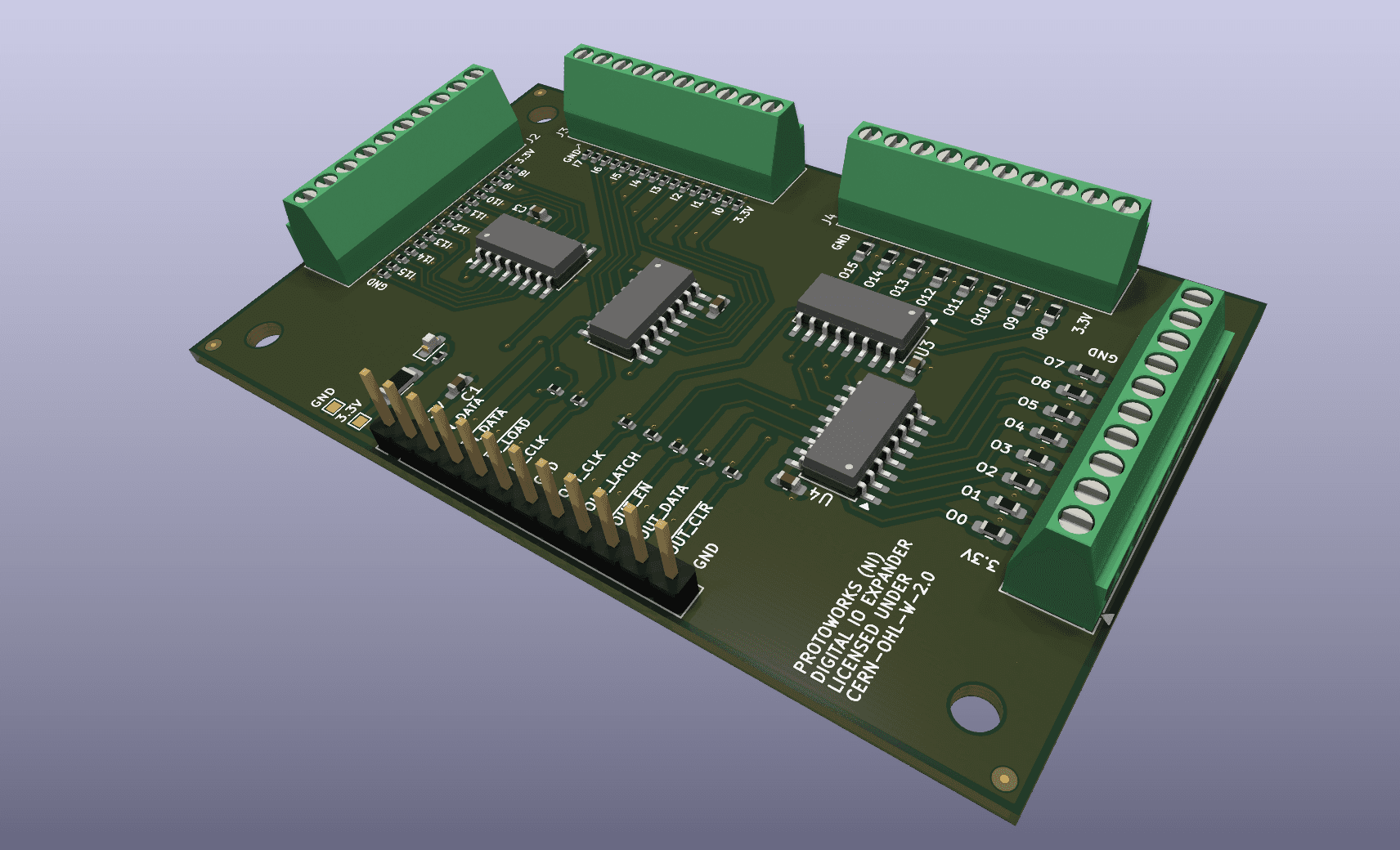
Digital IO Expander Board
A deterministic, shift-register-based expansion module providing 16 logic-level inputs and 16 logic-level outputs.
The Friction It Removes
Circuit & Layout Details
- Digital Inputs: Uses 2 x 74HC165 parallel-in, serial-out shift register to read the state of 8 logic-level lines.
- Digital Outputs: Uses 2 x 74HC595 serial-in, parallel-out shift register to drive 8 logic-level output lines.
- Connections: A centralized 12-pin header handles the microcontroller interface, while the 32 (16 inputs, 16 outputs) expanded digital IO lines are broken out to physical screw terminals for reliable bench wiring.
Protoworks Prototype Building Blocks
Utility modules for rapid and reliable bench testing
These boards are practical engineering modules rather than mass-market consumer products. They are utility modules—repeatable, validated circuits for common functions that appear across multiple embedded projects. Rather than rebuilding basic power rails, communication interfaces, or IO arrays from scratch on a piece of protoboard, these blocks provide a known-good starting point. These designs can also be customized and adapted to fit the specific needs of individual customer projects.
The development process, design decisions, and bench-testing phase of some of these boards are documented in detail within the Field Notes section, which links directly to the founder's personal engineering journal at JKTDEV.CO.UK.
Need a prototype board adapted for your project?
These boards are available as starting points for custom embedded, automation, and hardware prototyping work. Small sample batches may also be available while designs are being validated.
Contact ProtoworksOverview & Approach
🔧 Development Focused
Through-hole headers and connectors are left unpopulated by default, giving you maximum flexibility in how you wire them into your project, prototype bench, or enclosure.
📡 4-Layer Layouts
Standardized around 4-layer PCBs to provide cleaner power and ground referencing, helping reduce avoidable layout-related noise during early testing.
📝 BOM Transparency
Designed using standard, readily available 0603 and 0805 component footprints. Fully open hardware under the CERN-OHL-W-2.0 licence, with KiCad project files and multi-supplier bills of materials.
🛡️ Basic Safeguards
Built with practical workbench protection features intended to reduce damage from common prototyping mistakes, such as brief shorts, transients, and some reverse-polarity wiring errors.
⚡ Power
Reliable power delivery, voltage regulation, and transient protection modules designed to provide a stable foundation for hardware prototyping.
USB-C Power Input & 3.3 V Regulator Board
A simple power entry utility that combines USB-C power handling with a local 3.3 V regulated rail.
The Friction It Removes
Circuit & Layout Details
- Regulator: Based on the AP2114D-3.3 linear regulator (LDO) providing a stable 3.3 V output.
- Input Protection: Includes a 500 mA hold / 1 A trip PPTC resettable fuse, an SMAJ5.0A TVS diode on VBUS for transient clamping, and an MBR130LSFT1G Schottky diode for basic backfeed protection.
- Data Protection: Includes a USBLC6-2SC6 ESD protection array on the D+ and D− lines, which are broken out to pins for optional connection to external USB-to-UART converters.
- Power Gating: Features a solder jumper to disconnect the power indicator LED when minimizing power budgets for low-power or battery-operated testing.
- Interface: Standard 2.54 mm breakout pins for 5 V, 3.3 V, GND, D−, and D+, with dual M2 mounting holes for temporary bench installation.
USB-C Data Shield (USB Condom)
A hardware-level data blocker that allows safe device charging from public or untrusted USB-C ports by physically isolating all data lines.
The Friction It Removes
Circuit & Layout Details
- Physical Data Isolation: Complete severance of USB-C high-speed and legacy data lines (D+, D−, TX+, TX−, RX+, RX−, SBU1, SBU2). There are no copper trace connections for these pins between the input and output connector footprints.
- Basic Charging Support: Uses dedicated 5.1 kΩ pull-down resistors (Rd) on the Configuration Channel (CC) lines. This advertises a standard UFP (Upstream Facing Port) role to the power source, enabling basic 5 V charging (up to 1.5 A or 3.0 A depending on source capability) without Power Delivery (PD).
- No PD Negotiation: Intentionally bypasses USB Power Delivery (PD) controllers to ensure the voltage never climbs above a baseline 5 V, protecting the connected device from unexpected high-voltage negotiation or protocol exploits.
- ESD Protection: Features a high-speed TVS diode array on the VBUS power rail to protect the connected device from electrostatic discharge and public charger power surges.
📡 Communications
Robust differential signaling and serial interface converters designed for reliable data transmission in noisy environments and over long distances.
RS485 Breakout with 48 V Passthrough Board
A straightforward non isolated differential serial interface for testing robust communication over longer cable runs, featuring a 48 V power passthrough option.
The Friction It Removes
Circuit & Layout Details
- Transceiver: Based on the 3.3 V MaxLinear SP3485EN differential transceiver.
- Bus Configuration: Includes onboard jumper-selectable 120 Ω bus termination and selectable bus biasing (using either stronger 1 kΩ or weaker 4.7 kΩ resistors) to establish the idle state of the bus.
- Direction Control: A single jumper links the DE and /RE lines, allowing a single microcontroller GPIO to control the transmit/receive state.
- 48 V Passthrough: Routes a high-voltage auxiliary supply across nodes for distributed systems. The 48 V path is protected by a conventional SMD fuse, a TVS diode, and P-channel MOSFET reverse-polarity protection.
- Layout Separation: Non-isolated design, but laid out with physically distinct 48 V return and logic ground regions to prevent heavy current return loops from interfering with low-voltage logic references.
RS485 Non Isolated Breakout Board
A clean, non-isolated differential serial interface focusing purely on low-noise half-duplex communication without auxiliary high-voltage power routing.
The Friction It Removes
Circuit & Layout Details
- Transceiver: Based on the 3.3 V MaxLinear SP3485EN differential transceiver.
- Bus Configuration: Includes onboard jumper-selectable 120 Ω bus termination and selectable bus biasing (using either stronger 1 kΩ or weaker 4.7 kΩ resistors) to establish the idle state of the bus.
- Direction Control: DE and /RE lines are optionally linked via jumper to a single microcontroller GPIO to easily control half-duplex transmit/receive states.
- ESD Protection: Features a dedicated TVS array to protect against electrostatic discharge (ESD) and transients on the differential bus lines.
🎛️ Input / Output (I/O)
Deterministic, shift-register-based input/output expansion modules to scale digital logic pins without complex protocol overhead or bus lockup risks.
Digital IO Expander Board
A deterministic, shift-register-based expansion module providing 16 logic-level inputs and 16 logic-level outputs.
The Friction It Removes
Circuit & Layout Details
- Digital Inputs: Uses 2 x 74HC165 parallel-in, serial-out shift register to read the state of 8 logic-level lines.
- Digital Outputs: Uses 2 x 74HC595 serial-in, parallel-out shift register to drive 8 logic-level output lines.
- Connections: A centralized 12-pin header handles the microcontroller interface, while the 32 (16 inputs, 16 outputs) expanded digital IO lines are broken out to physical screw terminals for reliable bench wiring.