
Protoworks Prototype Building Blocks
Open-source PCB design files and documentation
I share reusable circuit and PCB designs for embedded prototypes, test rigs and custom hardware projects. They cover common functions such as power entry, serial communication, protection and digital I/O, with each listing showing its stage of development.
For now, I offer design files and documentation only. Bare PCBs, assembled boards, kits and sample units are not currently available. Photos show prototypes built for development and testing.
The development process, design decisions, and bench-testing phase of some of these boards are documented in detail within the Field Notes section, which links directly to the founder's personal engineering journal at JKTDEV.CO.UK.
Need a prototype board adapted for your project?
I can adapt a circuit or PCB design and develop embedded firmware for your project. I agree the design files, documentation and any development testing with you before work starts.
Contact meOverview & Approach
🔧 Development Focused
The designs leave through-hole headers and connectors for you to choose, giving you flexibility when arranging your own build and wiring.
📡 4-Layer Layouts
Standardized around 4-layer PCBs to provide cleaner power and ground referencing, helping reduce avoidable layout-related noise during early testing.
📝 BOM Transparency
All Boards predominantly use readily available 0603/0805 components, while the self-assembly-focused Just Boards range uses larger footprints where practical. Fully open hardware under the CERN-OHL-W-2.0 licence, with KiCad project files and bills of materials.
🛡️ Basic Safeguards
The circuit designs include practical workbench protection features intended to reduce damage from common prototyping mistakes, such as brief shorts, transients and some reverse-polarity wiring errors.
PCB Designs for Home Assembly
The Just Boards range provides design files for bare printed circuit boards, breakout adapters and programming fixtures intended for self-assembly at home or on the workbench.
These designs deliberately avoid microscopic assembly challenges by utilizing standard 2.54 mm through-hole components and accessible 1206-size SMT footprints (or SMT components of a similar size). This ensures they can be easily hand-soldered with basic soldering equipment using widely available components sourced affordably from mainstream retailers such as Amazon, AliExpress, and general electronic hobbyist suppliers.
The Just Boards badge identifies these designs in the catalogue. You can use the design files to arrange your own PCB fabrication, component sourcing and assembly.
Design Development Status
Status labels track design progress and internal prototype testing, from planning and PCB layout through test builds and eventual retirement.
| Status | Description |
|---|---|
| Planning | Board is in the early planning stages before design. |
| In Design | Board is currently being actively designed. |
| Awaiting Fabrication | The design is ready for an internal prototype test build. |
| In Fabrication | An internal prototype test build is being fabricated. |
| Bench-Tested Design | Prototypes have been built and bench-tested during design development. |
| Halted | Designs that are currently not prioritised or not economical to produce. |
| Retired / Replaced | Earlier designs are kept visible for transparency and development history. |
Bench-Tested Designs
Circuit and PCB designs with prototypes built and bench-tested during development. The listings describe the designs and their features; current deliverables are design files and documentation.
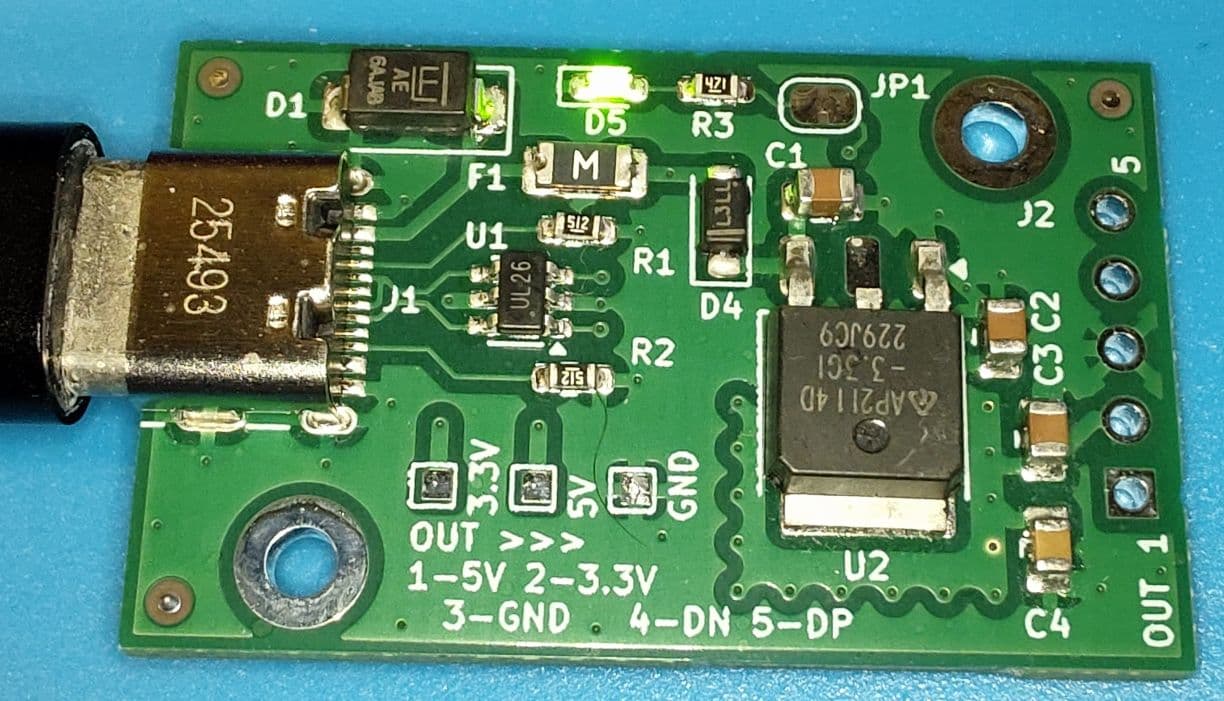
USB-C Power Input & 3.3 V Regulator Board
A simple power entry utility that combines USB-C power handling with a local 3.3 V regulated rail.
Why This Board Exists
Circuit & Layout Details
- Regulator: Based on the AP2114D-3.3 linear regulator (LDO) providing a stable 3.3 V output.
- Input Protection: Includes a 500 mA hold / 1 A trip PPTC resettable fuse, an SMAJ5.0A TVS diode on VBUS for transient clamping, and an MBR130LSFT1G Schottky diode for basic backfeed protection.
- Data Protection: Includes a USBLC6-2SC6 ESD protection array on the D+ and D− lines, which are broken out to pins for optional connection to external USB-to-UART converters.
- Power Gating: Features a solder jumper to disconnect the power indicator LED when minimizing power budgets for low-power or battery-operated testing.
- Interface: Standard 2.54 mm breakout pins for 5 V, 3.3 V, GND, D−, and D+, with dual M2 mounting holes for temporary bench installation.
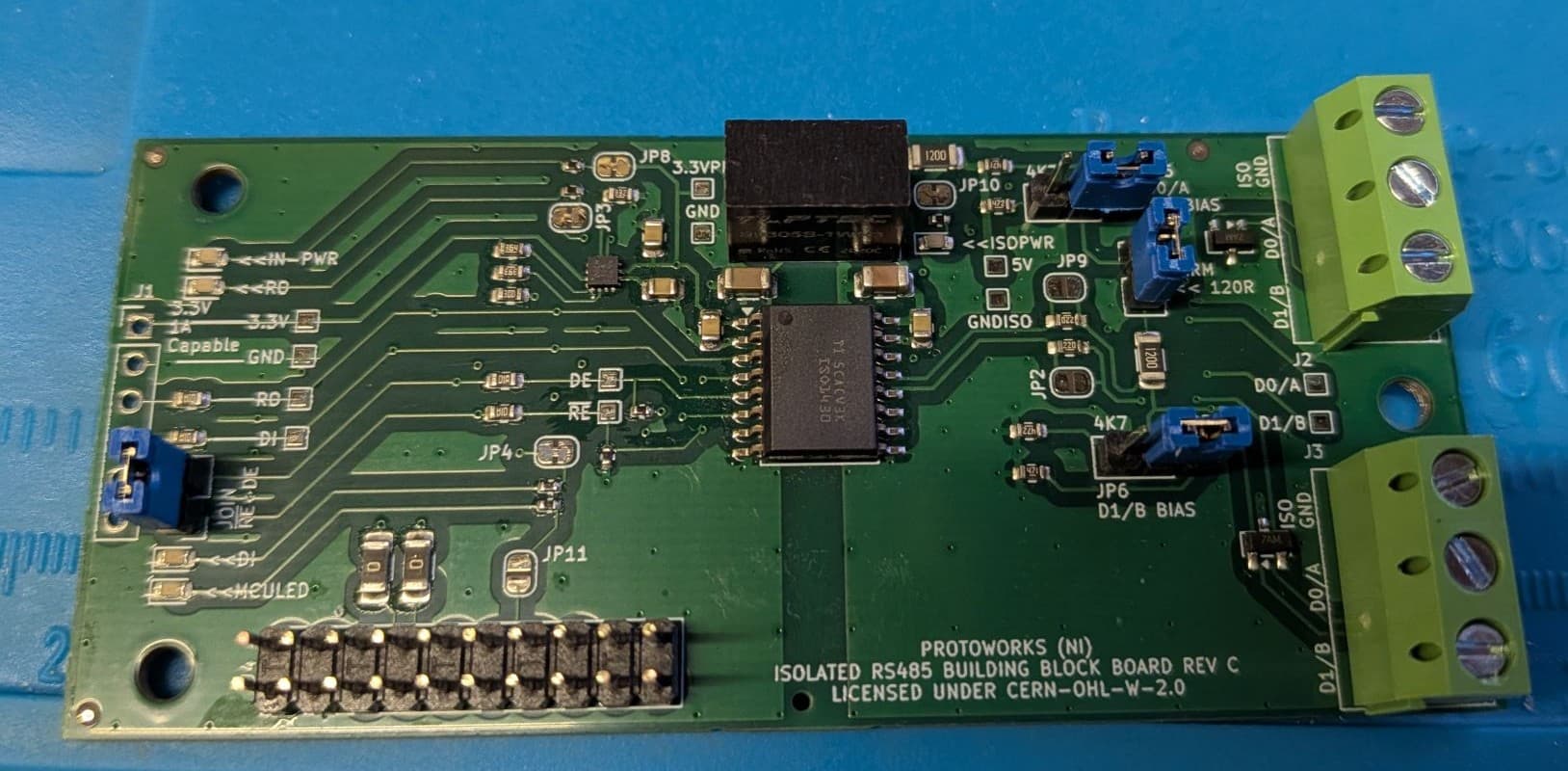
RS485 Isolated Carrier Board
An isolated differential serial carrier board providing galvanic isolation between host control systems and the RS485 communication bus, integrated with eFuse protection and a UCMOD MCU socket.
Why This Board Exists
Circuit & Layout Details
- Galvanic Isolation: Complete galvanic isolation between logic-side control circuitry and the RS485 differential bus lines to suppress ground loops and high-voltage transients.
- UCMOD MCU Socket: Features a standardized UCMOD port allowing plugin microcontroller modules to dock directly onto the carrier board.
- eFuse Protection: Integrated active eFuse protection to safeguard board circuitry against overcurrent and fault events.
- Updated Isolated Power: Upgraded onboard isolated DC-DC converter for efficient power delivery to the bus-side transceiver.
- Bus Configuration: Jumper-selectable 120 Ω bus termination and A/B bus biasing networks to maintain defined idle bus states.
- Direction Control: Configurable jumper links for DE and /RE lines to manage half-duplex transmit and receive transitions from host GPIOs.
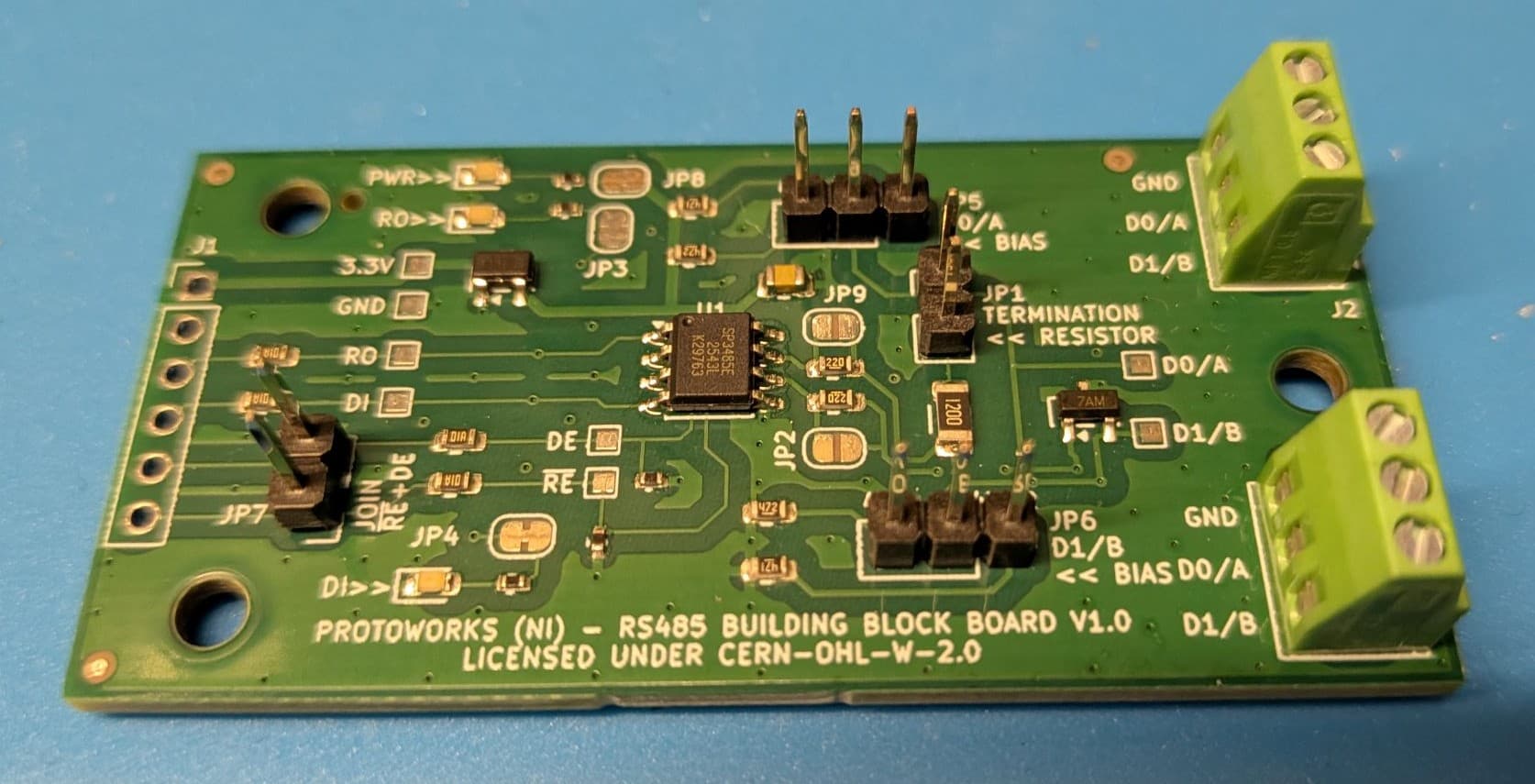
RS485 Non-Isolated Breakout Board
A clean, non-isolated differential serial interface focusing purely on low-noise half-duplex communication for local or bench-scale networks.
Why This Board Exists
Circuit & Layout Details
- Transceiver: Based on the 3.3 V MaxLinear SP3485EN differential transceiver.
- Bus Configuration: Includes onboard jumper-selectable 120 Ω bus termination and selectable bus biasing using either stronger 470 Ω or weaker 4.7 kΩ resistors to establish the idle state of the bus.
- Direction Control: DE and /RE lines are optionally linked via jumper to a single microcontroller GPIO to easily control half-duplex transmit/receive states.
- ESD Protection: Features a dedicated TVS array to protect against electrostatic discharge (ESD) and transients on the differential bus lines.
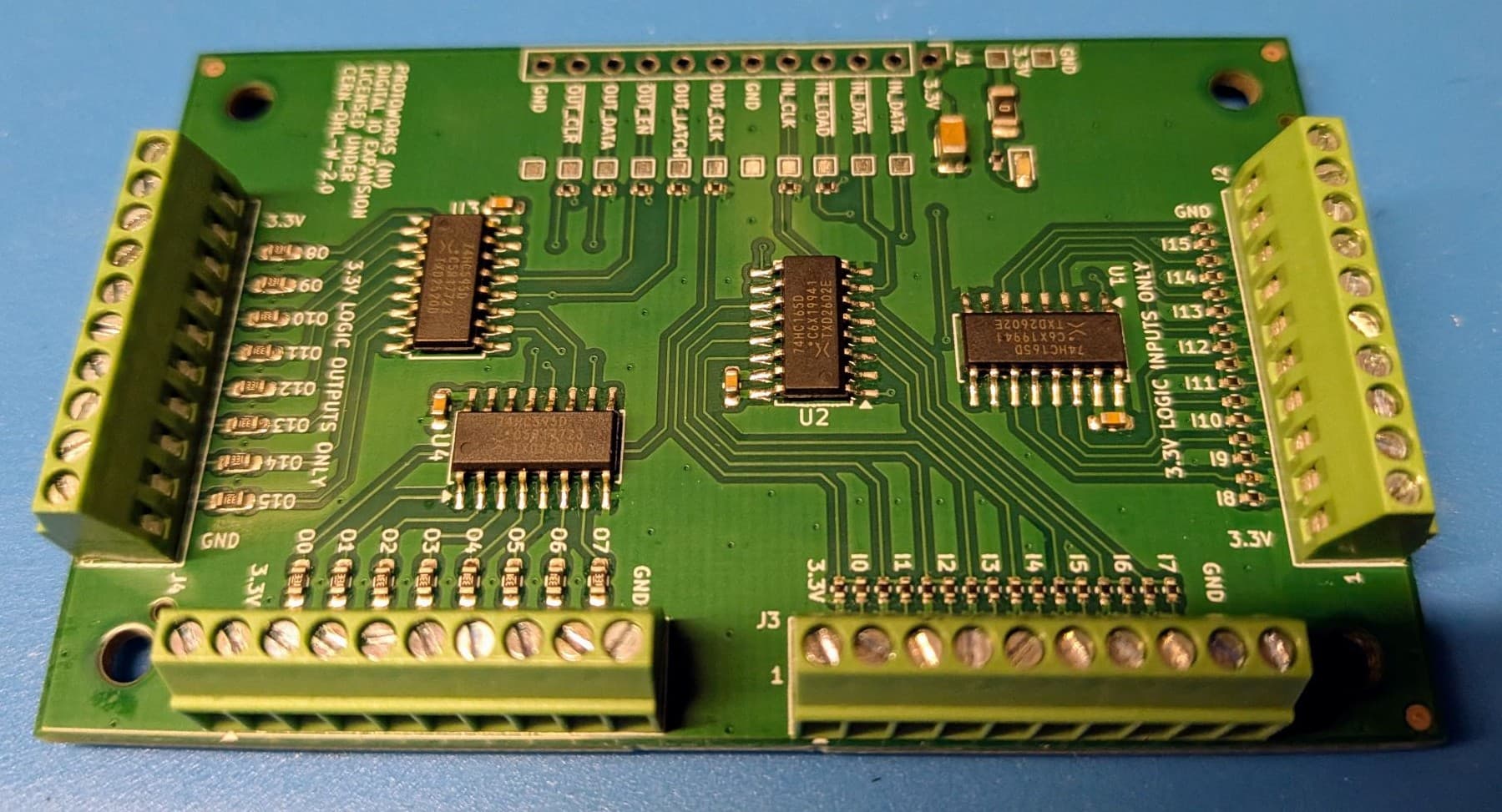
Digital IO Expander Board
A deterministic, shift-register-based expansion module providing 16 logic-level inputs and 16 logic-level outputs.
Why This Board Exists
Circuit & Layout Details
- Digital Inputs: Uses 2 x 74HC165 parallel-in, serial-out shift registers to read 16 logic-level input lines.
- Digital Outputs: Uses 2 x 74HC595 serial-in, parallel-out shift registers to drive 16 logic-level output lines.
- Connections: A centralized 12-pin header handles the microcontroller interface, while the 32 expanded digital I/O lines are broken out to physical screw terminals for reliable bench wiring.
UCMOD-0 Microcontroller Module
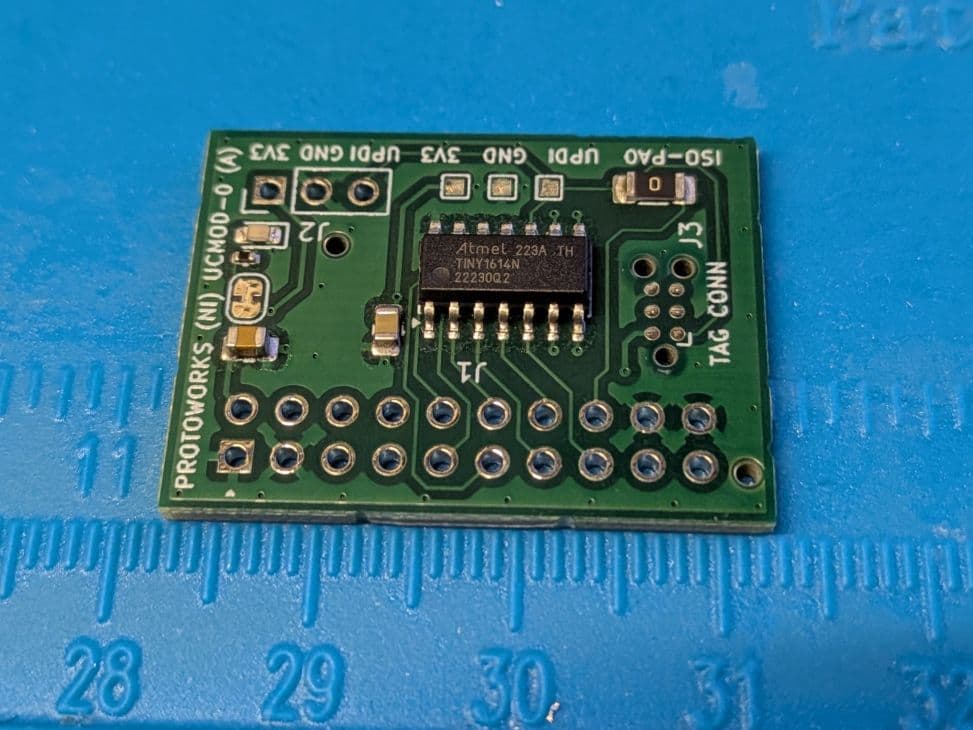
An ATtiny1614-based pluggable microcontroller module featuring a UCMOD connector to provide microcontroller compute power to Protoworks carrier boards.
Why This Board Exists
Circuit & Layout Details
- Microcontroller Core: Powered by the Microchip ATtiny1614 8-bit AVR microcontroller (16 KB Flash, 2 KB SRAM).
- UCMOD Connector: Integrated UCMOD connector designed to plug directly into the UCMOD socket of Protoworks carrier boards.
- Programming Interface: Onboard Tag-Connect TC2030-IDC-NL footprint for fast UPDI programming and debugging.
- Modular Design: Enables flexible compute integration across custom test rigs and carrier board setups.
UPDI Friend to Tag-Connect Adapter Board
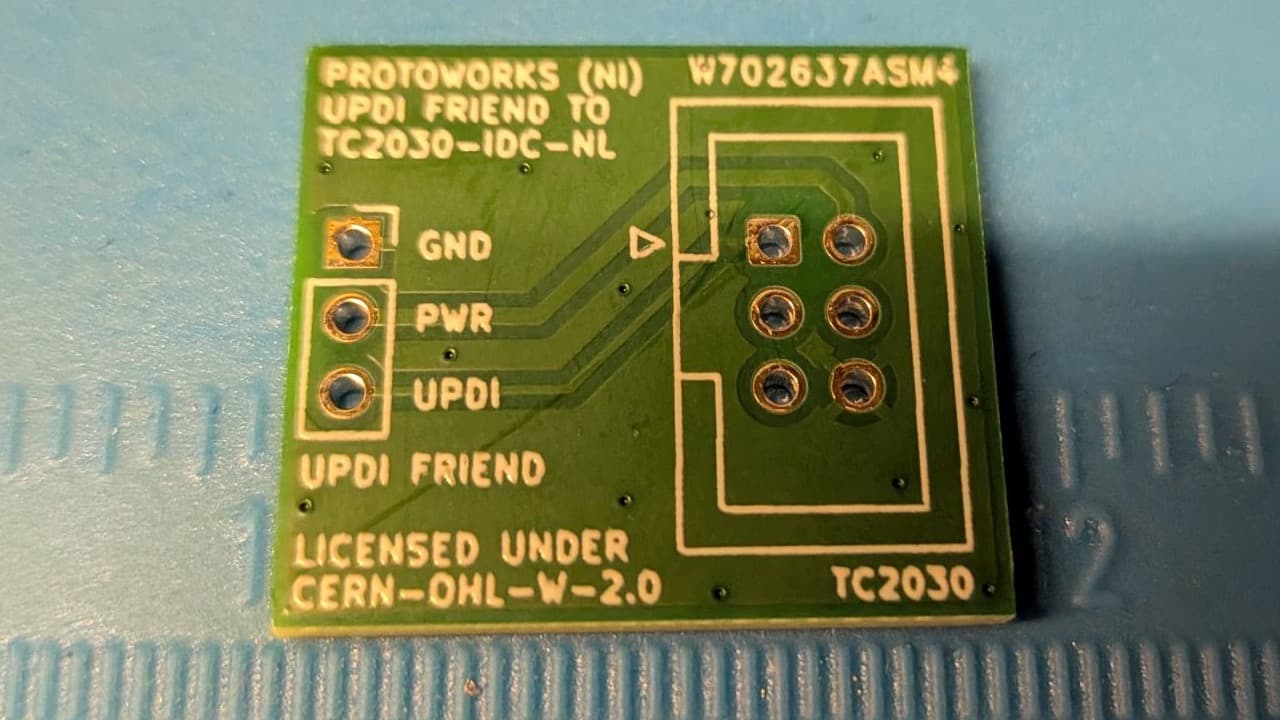
A compact adapter PCB (part of the Just Boards range) designed to connect an UPDI Friend programmer to a Tag-Connect TC2030-IDC-NL cable for flashing microcontrollers.
Why This Board Exists
Circuit & Layout Details
- UPDI Friend Interface: Standard 2.54 mm header footprint mapping UPDI data, power, and ground signals from the UPDI Friend programmer.
- Tag-Connect TC2030 Footprint: Standard Tag-Connect TC2030-IDC-NL 6-pin footprint for spring-pin programming cables.
- UCMOD-0 Target Compatibility: Optimized pinout routing designed to program ATtiny 1614-based UCMOD-0 microcontroller plugin boards.
- Layout & Assembly: Compact 2-layer PCB routing with minimal component count using standard through-hole pin headers for fast bench assembly.
Planned / In Design
New board designs currently in active planning, schematic development, and PCB layout stages.
Boards in this section are subject to changing features and scheduling while designs are refined, so listed specifications, connectors, and timelines may differ in the finished hardware. I welcome feedback on the features offered — including suggestions for additional functionality or changes — and will consider any request that is technically feasible within each board's design constraints.
UCMOD Breakout Board PCB
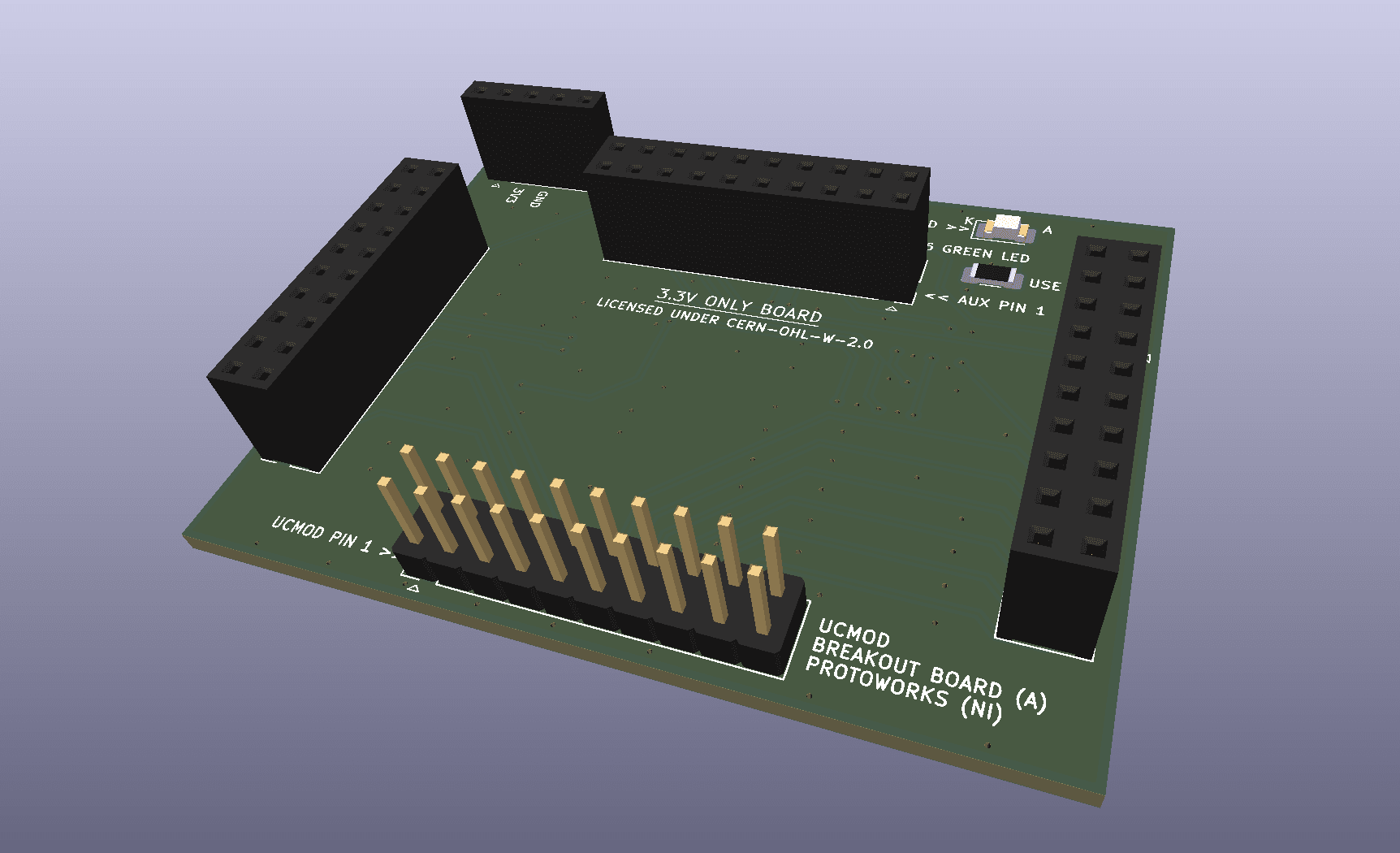
A bench breakout board (part of the Just Boards range) designed to interface the UCMOD microcontroller module with standard 2.54 mm pitch headers for rapid breadboarding and testing.
Why This Board Exists
Circuit & Layout Details
- UCMOD Socket: Dedicated 20-pin socket connector matching the standard UCMOD microcontroller module pinout.
- Power Breakout Header: Dedicated power interface header allowing the breakout board to accept power directly from a modular power board (such as the USB-C Power Input & 3.3 V Regulator Board) or external bench supplies.
- Standard Breadboard Headers: Dual 10-pin 2.54 mm pitch header footprints breaking out I2C (SCL/SDA), UART (TX/RX), SPI (MOSI/MISO/SCK/CS), analog inputs/DAC (AN0–AN3), and power rails.
- Power Indication: Onboard footprint for a 1206 green power indicator LED with a 470 Ω current-limiting resistor on the 3.3 V rail.
- QWIIC Connector: Onboard 4-pin QWIIC connector (JST-SH 1.0 mm pitch) for plug-and-play daisy-chaining of external I2C sensors and accessories without soldering.
- OLED / I2C Connector: Dedicated pin header for connecting standard 4-pin I2C OLED displays and external I2C expansion boards.
- Layout & Assembly: Designed on a 2-layer PCB utilizing standard 2.54 mm through-hole headers and larger 1206 SMT footprints for easy hand-soldering.
UCMOD-L-STM32 Microcontroller Module
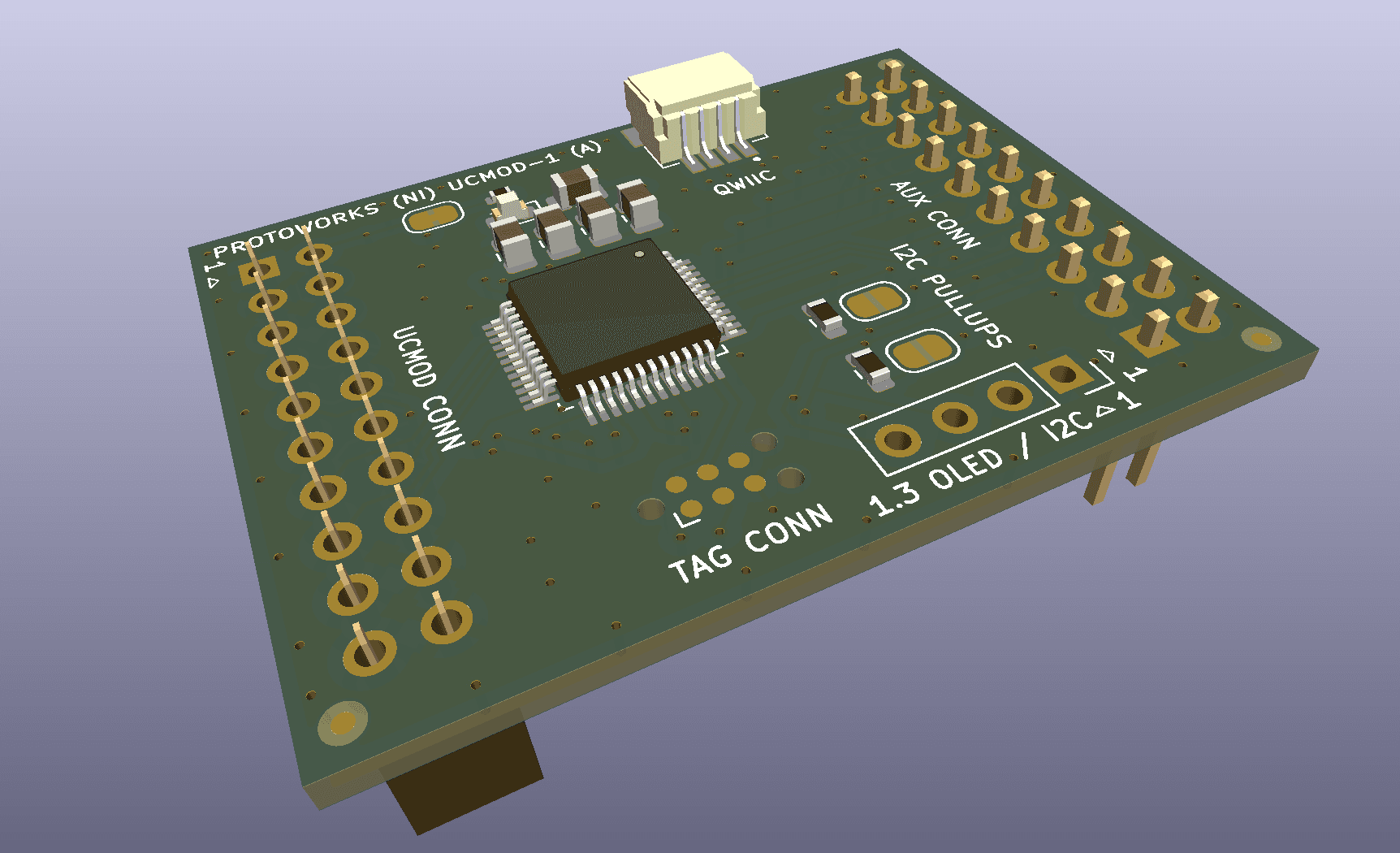
An STM32G0B1CBT6-based pluggable microcontroller module featuring integrated CAN peripheral support, a UCMOD connector, an auxiliary expansion connector, and a Tag-Connect interface to deliver 32-bit ARM Cortex-M0+ processing power to Protoworks carrier boards (including the CAN Carrier Board).
Why This Board Exists
Circuit & Layout Details
- Microcontroller Core: Powered by the STMicroelectronics STM32G0B1CBT6 32-bit ARM Cortex-M0+ microcontroller (512 KB Flash, 144 KB RAM, operating up to 64 MHz) with integrated hardware CAN/FDCAN peripheral support.
- UCMOD Connector: Integrated UCMOD connector designed to plug directly into the UCMOD socket of Protoworks carrier boards and breakout adapters.
- Auxiliary Connector: Dedicated auxiliary expansion connector exposing additional microcontroller GPIOs, timers, and peripheral signals beyond the base UCMOD bus.
- CAN Carrier Compatibility: Hardware CAN controller signals are routed to interface seamlessly with the Protoworks CAN Carrier Board.
- Programming Interface: Onboard Tag-Connect TC2030-IDC-NL footprint for fast SWD (Serial Wire Debug) programming and real-time debugging.
- Modular Compute: High-performance 32-bit MCU module for complex control routines, communications protocol handling, and real-time sensor processing.
UCMOD-S-ATT Microcontroller Module
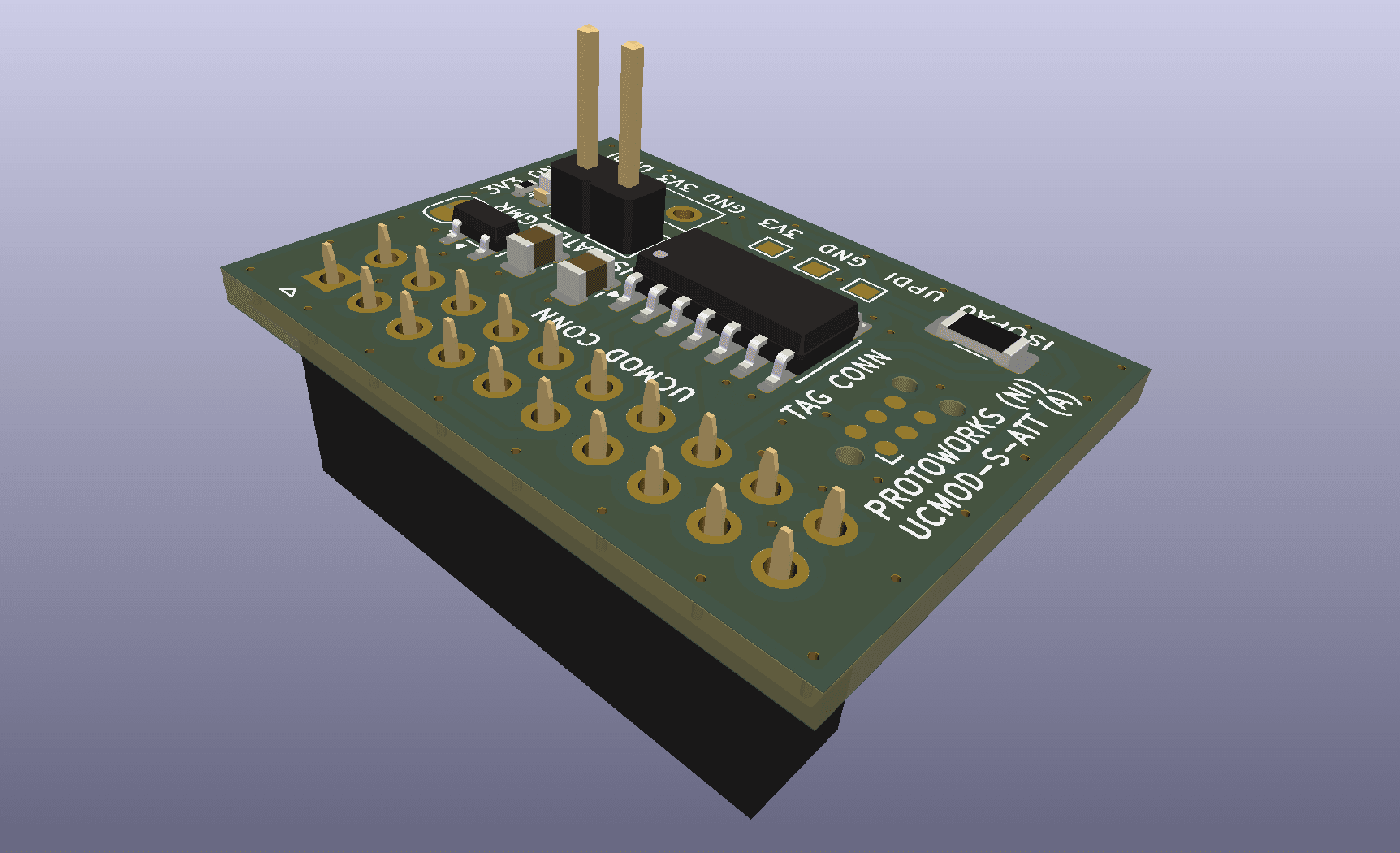
The successor to the original UCMOD-0 module, providing an updated revision of the ATtiny1614-based pluggable microcontroller board that incorporates reverse polarity protection for programmer power and minor pin header adjustments for enhanced bench prototyping reliability.
Why This Board Exists
Circuit & Layout Details
- Microcontroller Core: Powered by the Microchip ATtiny1614 8-bit AVR microcontroller (16 KB Flash, 2 KB SRAM, up to 10 MHz).
- Reverse Polarity Protection: Integrated reverse polarity protection on the programmer power input to safeguard circuitry against accidental reversed wiring.
- Pin Header Adjustment: Minor physical adjustments to the pin header layout for cleaner mechanical alignment and easier mating with carrier board sockets.
- UCMOD Connector: Standard 20-pin UCMOD connector pinout designed to plug directly into the UCMOD socket of Protoworks carrier boards and breakout adapters.
- Programming Interface: Tag-Connect TC2030-IDC-NL footprint for fast UPDI programming and debugging.
RS485 Isolated Carrier Board Rev B
An updated revision of the isolated differential serial carrier board, refining active eFuse protection, isolated DC-DC power delivery, and UCMOD MCU docking for enhanced industrial prototype networking.
Why This Board Exists
Circuit & Layout Details
- Galvanic Isolation: Galvanically isolates logic-side host and microcontroller circuitry from the differential RS485 bus lines to eliminate ground loops and prevent damage from high common-mode surges.
- Isolated Power Delivery: High-efficiency onboard isolated DC-DC converter powering the bus-side transceiver circuitry.
- eFuse & Transient Protection: Active eFuse circuitry with TVS transient suppression on differential lines for overcurrent, inrush, and ESD protection.
- UCMOD Socket: Standard 20-pin UCMOD connector socket to directly host microcontroller modules (e.g. UCMOD-S-ATT, UCMOD-S-CH32, or UCMOD-L-STM32).
- Bus Configuration: Jumper-selectable 120 Ω bus termination and biasing networks, with single-GPIO DE//RE direction control.
CAN Carrier Board
An isolated Controller Area Network (CAN) carrier board designed to provide robust differential bus communication, equipped with galvanic isolation, active eFuse protection, ESD protection, and both the standard UCMOD Connector and Auxiliary UCMOD Connector for expanded microcontroller interfacing.
Why This Board Exists
Circuit & Layout Details
- Galvanic Isolation: Galvanically isolates logic-side microcontroller circuitry from the differential CAN bus to prevent ground loops and provide high-voltage transient protection.
- UCMOD & Auxiliary Interface: Integrates both standard and auxiliary UCMOD socket interfaces for modular microcontroller plugins (the installed UCMOD MCU module must feature an integrated CAN bus peripheral).
- CAN Bus Physical Layer: Transceiver circuitry designed for robust differential communications over noisy, multidrop environments.
- eFuse Protection: Integrated active eFuse protection to safeguard board circuitry against overcurrent, inrush, and power fault events.
- ESD Protection: Dedicated TVS diode array on the differential CAN bus lines to protect against electrostatic discharge (ESD) and line transients.
- Bus Termination: Onboard jumper-selectable 120 Ω bus termination resistor.
RS485 Non-Isolated Breakout Board Rev B
An updated revision of the clean non-isolated differential serial interface, featuring an added UCMOD socket for directly hosting pluggable microcontroller compute modules alongside standard bench breakout headers.
Why This Board Exists
Circuit & Layout Details
- UCMOD Socket: Adds a standard 20-pin UCMOD socket interface to directly dock compatible microcontroller modules.
- Transceiver: Based on the 3.3 V MaxLinear SP3485EN differential transceiver for low-noise half-duplex communication.
- Bus Configuration: Includes onboard jumper-selectable 120 Ω bus termination and selectable bus biasing using either stronger 470 Ω or weaker 4.7 kΩ resistors to establish the idle state of the bus.
- Direction Control: DE and /RE lines are optionally linked via jumper to a single microcontroller GPIO to easily control half-duplex transmit/receive states.
- ESD Protection: Features a dedicated TVS array to protect against electrostatic discharge (ESD) and transients on the differential bus lines.
UCMOD-S-CH32 Microcontroller Module
A compact, ultra-low-cost pluggable microcontroller module powered by the WCH CH32V006 32-bit RISC-V microcontroller, delivering high-efficiency 32-bit computing, integrated timers, ADC, and communication peripherals to the UCMOD ecosystem.
Why This Board Exists
Circuit & Layout Details
- Microcontroller Core: Powered by the WCH CH32V006 32-bit RISC-V microcontroller (QingKe 32-bit core, up to 48 MHz, 64 KB Flash, 8 KB SRAM).
- UCMOD Connector: Standard 20-pin UCMOD connector pinout designed to plug directly into the UCMOD socket of Protoworks carrier boards and breakout adapters.
- Peripherals & I/O: Exposes hardware UART, I2C, SPI, 12-bit ADC channels, and multi-channel timer/PWM outputs mapped to the standard UCMOD interface.
- Single-Wire Debug: Onboard single-wire SDI interface footprint for rapid flashing, programming, and real-time debugging.
- Cost-Optimized Architecture: Ultra-efficient BOM and minimalistic component footprint ideal for high-volume nodes and low-cost modular prototyping.
Digital IO Expander Board Rev B
An updated revision of the deterministic shift-register IO expansion module, adding an integrated UCMOD connector socket to directly host microcontroller modules and correcting a minor silkscreen labeling issue from Rev A.
Why This Board Exists
Circuit & Layout Details
- UCMOD Socket: Integrates a standard 20-pin UCMOD socket interface to directly dock compatible microcontroller compute modules.
- Silkscreen Revision: Corrects silkscreen pin labeling from Rev A for clear, precise pin identification on the bench.
- Digital Inputs: Uses 2 x 74HC165 parallel-in, serial-out shift registers to read 16 logic-level input lines.
- Digital Outputs: Uses 2 x 74HC595 serial-in, parallel-out shift registers to drive 16 logic-level output lines.
- Connections: Centralized interface routing for UCMOD integration alongside physical screw terminals breaking out all 32 expanded digital I/O lines for reliable bench wiring.
UCMOD-L-PIC18 Microcontroller Module
A PIC18-Q35-based pluggable microcontroller module featuring a UCMOD connector, an auxiliary expansion connector, onboard QWIIC and OLED/I2C connectivity, and a Tag-Connect interface to deliver enhanced 8-bit PIC processing with integrated configurable logic to Protoworks carrier boards.
Why This Board Exists
Circuit & Layout Details
- Microcontroller Core: Powered by the Microchip PIC18-Q35 8-bit PIC microcontroller (up to 64 KB Flash, 4 KB SRAM, internal oscillator up to 64 MHz, 1.8–5.5 V operation).
- UCMOD Connector: Standard 20-pin UCMOD connector pinout designed to plug directly into the UCMOD socket of Protoworks carrier boards and breakout adapters.
- Auxiliary Connector: Dedicated auxiliary expansion connector exposing additional microcontroller GPIOs, timers, and peripheral signals beyond the base UCMOD bus.
- Configurable Logic: Utilises the PIC18-Q35 integrated Configurable Logic Block (CLB) with 128 logic elements for implementing custom digital logic on-chip without external glue components.
- Peripherals & I/O: Exposes hardware UART, SPI, I2C, 10-bit ADC with Computation (ADCC), and multi-channel PWM outputs mapped to the standard UCMOD interface.
- QWIIC Connector: Onboard 4-pin QWIIC connector (JST-SH 1.0 mm pitch) for plug-and-play daisy-chaining of external I2C sensors and accessories without soldering.
- OLED / I2C Connector: Dedicated pin header for connecting standard 4-pin I2C OLED displays and external I2C expansion boards.
- Programming Interface: Onboard Tag-Connect TC2030-IDC-NL footprint for fast ICSP (In-Circuit Serial Programming) programming and debugging.
- Modular Compute: 8-bit PIC module for classic control routines, simple communications protocol handling, and reliable general-purpose embedded prototyping.
📦 Retired & Halted Boards
Earlier design iterations, paused projects, and retired board revisions are maintained on a dedicated subpage for design transparency, hardware revision reference, and development history.
View Retired & Halted Boards →Need a prototype board adapted for your project?
I can adapt these circuit and PCB designs for your project, with the design files, firmware and documentation agreed before work starts.
Contact me